


SOLUTION
15
2025
-
09
Smart Water Meter Based on Supercapacitors
Intelligent water meters typically rely on built-in lithium batteries to control the opening and closing of water valves. Lithium batteries offer several advantages, including lightweight design, high energy density, and low self-discharge rates. However, since these smart water meters are not equipped with rechargeable circuits, the lithium batteries eventually lose their ability to supply sufficient power to the control circuitry after a certain period of use. As a result, the batteries must be replaced.
Intelligent water meters commonly rely on built-in lithium batteries to control the opening and closing of water valves. Lithium batteries offer several advantages, including lightweight design, high energy density, and low self-discharge rates. However, since these smart water meters are not equipped with rechargeable circuits, the lithium batteries eventually lose their ability to supply sufficient power to the control circuitry after a certain period, necessitating battery replacement. For both water meter manufacturers and water utility companies, performing on-site battery or meter replacements is a cumbersome and time-consuming task. More critically, the depletion of battery power occurs unpredictably. Without precise and timely monitoring of battery levels, reliable valve shut-off mechanisms may fail, leading to issues such as unaccounted water usage and unauthorized water diversion. This represents a critical limitation of internally-battery-powered smart water meters, directly impacting their widespread adoption and practical implementation. To address this challenge, water meter manufacturers have developed various solutions, such as minimizing power consumption by limiting static leakage current to below 10 µA, ensuring that the battery can sustain continuous operation for over five years. Achieving this goal places stringent demands on circuit design and component selection, thereby increasing both the complexity of the design process and the rigor of final product testing. Additionally, incorporating robust battery-level monitoring circuits further elevates production costs.
To address this critical bottleneck hindering the development of smart water meters, numerous manufacturers have already begun exploring a novel solution: replacing lithium batteries with supercapacitors in smart water meter applications. Supercapacitors are passive components that have only recently entered mass production in recent years. They occupy a unique position between traditional batteries and conventional capacitors, combining the high-current, rapid charge-discharge capabilities of capacitors with the energy-storage properties of batteries. Moreover, supercapacitors boast an exceptionally long service life. During discharge, they generate current by utilizing electrons moving between conductive materials—rather than relying on chemical reactions—thereby providing a reliable power source for connected devices.

Compared with batteries, supercapacitors have the following characteristics:
1. Ultra-low series equivalent resistance (LOW ESR) and power density more than tenfold that of lithium-ion batteries make it ideal for high-current discharge applications. (For instance, a single 4.7F capacitor can deliver an instantaneous current exceeding 18A), ensuring reliable operation of water meter control motor valves or solenoid valves.
2. Ultra-long lifespan: capable of over 500,000 charge-discharge cycles—500 times that of Li-Ion batteries and 1,000 times that of Ni-MH and Ni-Cd batteries. If the supercapacitor is charged and discharged 20 times daily, it can provide continuous use for up to 68 years.
3. Supports high-current charging, features short charge-discharge cycles, requires a simple charging circuit, and exhibits no memory effect.
4. Maintenance-free and fully sealed.
5. Wide temperature range: -40°C to +70°C; typical battery operating range is -20°C to 60°C. Manufactured by GTCAP. GTCAP Brand Button-Type Supercapacitors Operating temperatures range from -40℃ to +70℃, with a high-temperature series available from -40℃ to +85℃.
Compared to smart water meters equipped with built-in lithium batteries, this solution replaces the lithium battery with a supercapacitor, which is integrated into the meter and externally powered by a dry-cell battery. Normally, the dry-cell battery supplies power to the meter's circuitry and charges the supercapacitor. When it becomes necessary to open the water valve, the system first checks whether the supercapacitor has stored sufficient energy. If not, the valve remains closed. However, if the supercapacitor contains adequate energy, the external dry-cell battery provides the necessary power to activate the water valve. Conversely, when closing the valve, if the external battery fails to supply sufficient energy, the supercapacitor steps in at that moment to ensure the valve is properly shut off. This setup functions much like a water storage tank: it accumulates water during normal operation and releases it when water supply is interrupted, ensuring continuous functionality even in the event of a temporary outage.
This solution is clearly superior to the previous design, with the following advantages:
1. The battery is detached from the water meter, eliminating the need to account for battery life and thereby extending the operational lifespan of the meter.
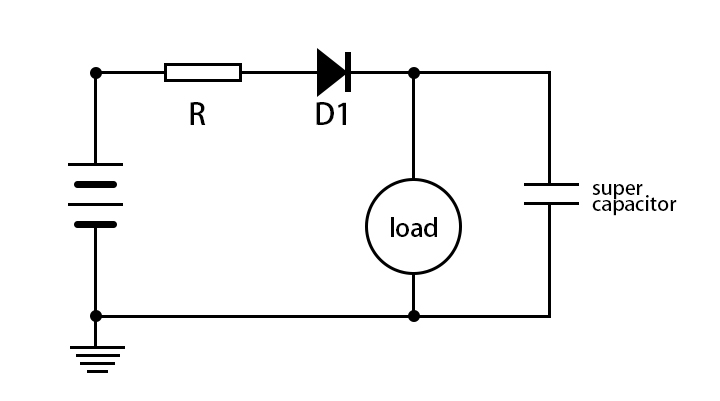
2. On the other hand, the high-current discharge characteristics of the supercapacitor ensure reliable operation of the water valve closure. Even when the external dry battery power is insufficient, the energy stored in the supercapacitor can still be used to reliably shut off the water valve.
3. Previously, the focus was solely on minimizing leakage current to ensure the battery's lifespan. However, after switching to supercapacitors, the leakage current specification has become less critical. If the battery runs low, users can replace it at any time. This approach not only simplifies circuit design and reduces the number of factory inspection procedures but also lowers overall product costs.
This solution addresses the current shortcomings of smart water meters, paving a new path for the development of intelligent metering technology.
Keywords
Previous page
Next page
Previous page
Next page
Related information


